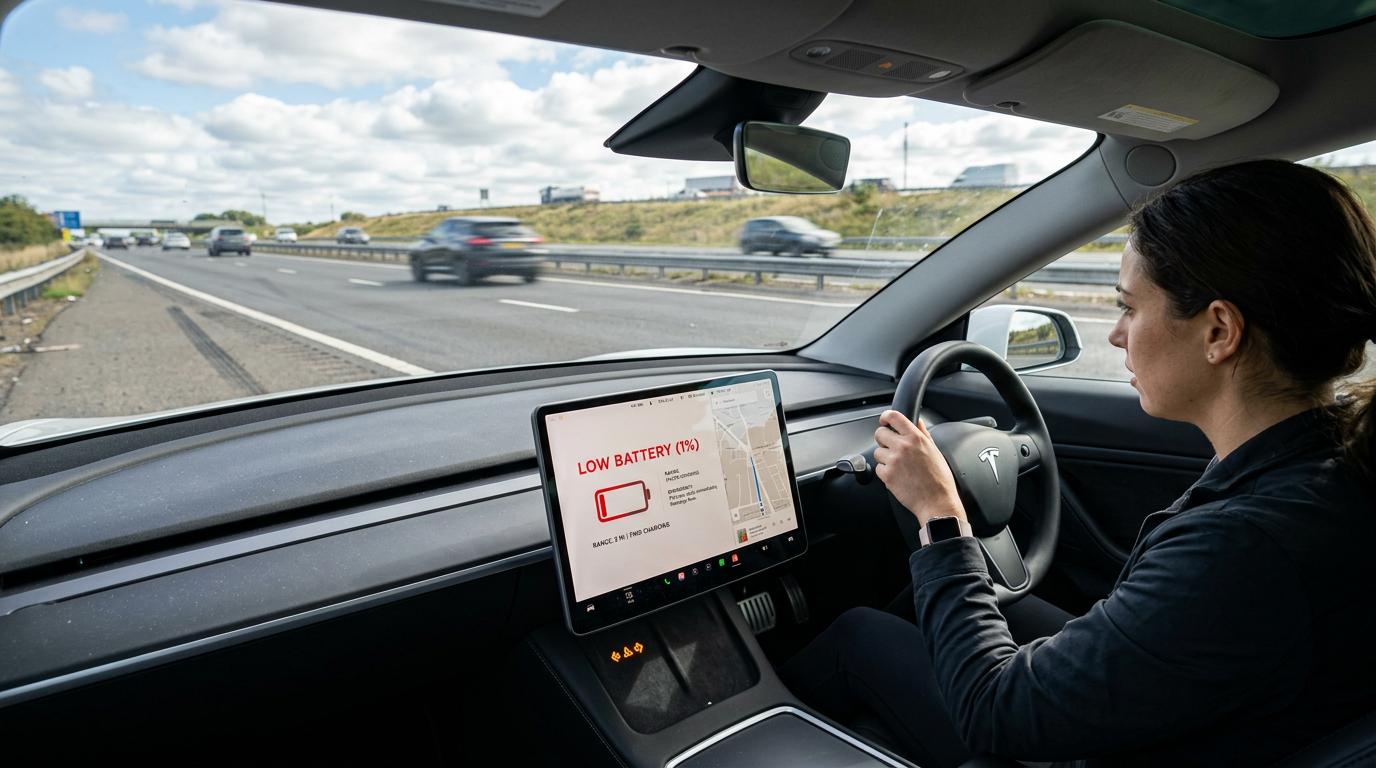
Tesla vehicles are among the most popular EVs on the road — and that means a lot of Tesla drivers will eventually face a dead battery far from a Supercharger. Whether you are in a Model 3, Model Y, Model S, or Model X, the experience is the same: reduced power mode, then shutdown.
This guide covers Tesla-specific emergency solutions, what the manufacturer roadside program actually includes, charging port compatibility, and when a mobile EV charging service may be an alternative to waiting for a tow.
What Happens When a Tesla Runs Out of Charge
As your Tesla battery drops to critical levels, the vehicle enters a series of warnings and power-reduction states:
- Below ~10% — range anxiety warnings and navigation prompts to the nearest charger
- Below ~5% — the car may limit top speed and acceleration to conserve energy
- At 0% — "turtle mode" activates with severely limited speed, then the car stops completely
- Once fully shut down, the car needs external energy to move — either a charge or a flatbed tow
Tesla Roadside Assistance: What It Actually Covers
Tesla includes roadside assistance for vehicles under warranty, but there are important limitations for battery depletion:
- Tesla roadside typically dispatches a flatbed tow truck — they do not bring a charger to you
- The tow is limited to a certain mileage (usually 50 miles) to the nearest Tesla Service Center or Supercharger
- Wait times can be 1–3 hours depending on location and demand
- Out-of-warranty vehicles may be charged for the tow
- The service does not charge your car on-site — you still need to wait for a full charge at the destination
Tesla Charging Port Compatibility
Since 2023, Tesla vehicles in North America use the NACS (North American Charging Standard) port, which is becoming the industry standard. Older Tesla vehicles use a proprietary connector. Mobile EV charging operators in the EEE Rescue network carry adapters for both standards, so compatibility is not a concern when you call for help.
The Fastest Tesla Emergency Charging Solution
Where a local operator is available, mobile EV charging can be a practical alternative to a tow. Here is how it works:
- Where service is available, dispatch confirms pricing and estimated arrival, then a mobile operator charges your car on-site
- You drive away — no flatbed, no dealership detour
- Dispatch confirms NACS/Tesla compatibility with the local operator before service
- Cost starts at $199, often less than an out-of-pocket heavy-duty tow
- Pricing and estimated arrival confirmed before dispatch
How to Call EEE Rescue for Tesla Emergency Charging
Call our dispatch line at (916) 826-9410 or submit a request at eeerescue.com/emergency-request. Let dispatch know your Tesla model, your location, and that your battery is depleted. Where service is available, dispatch confirms pricing and estimated arrival before an independent local operator is sent to your vehicle.
EV Out of Charge? Get Help Now
EEE Rescue connects drivers with independent local mobile EV charging operators where service is available. Emergency charging starts at $199, and dispatch confirms pricing and estimated arrival before service.
Frequently Asked Questions
EEE Rescue is a nationwide EV charging network and dispatch service. We connect customers with independent, licensed local contractors for regulated electrical work. EEE Rescue does not perform electrical installation directly. Pricing, availability, permits, and timelines vary by location and project and are confirmed by the independent professional handling your job.